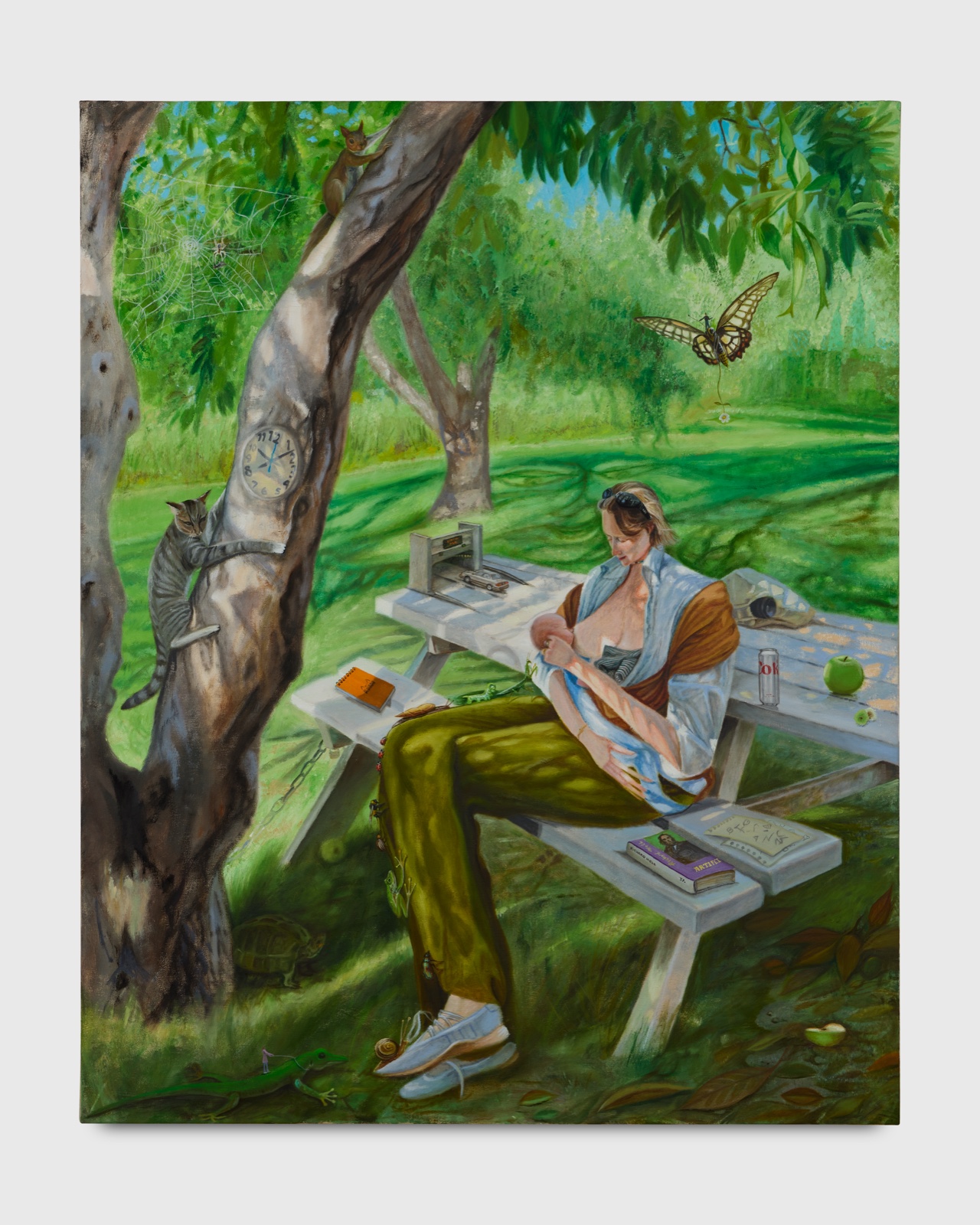
Oil on linen · 2026 · 160 × 150 cm · 63 × 59 in
There is a particular way a new father looks at the world. Slower. More careful. As if the light has changed, or his eyes have.
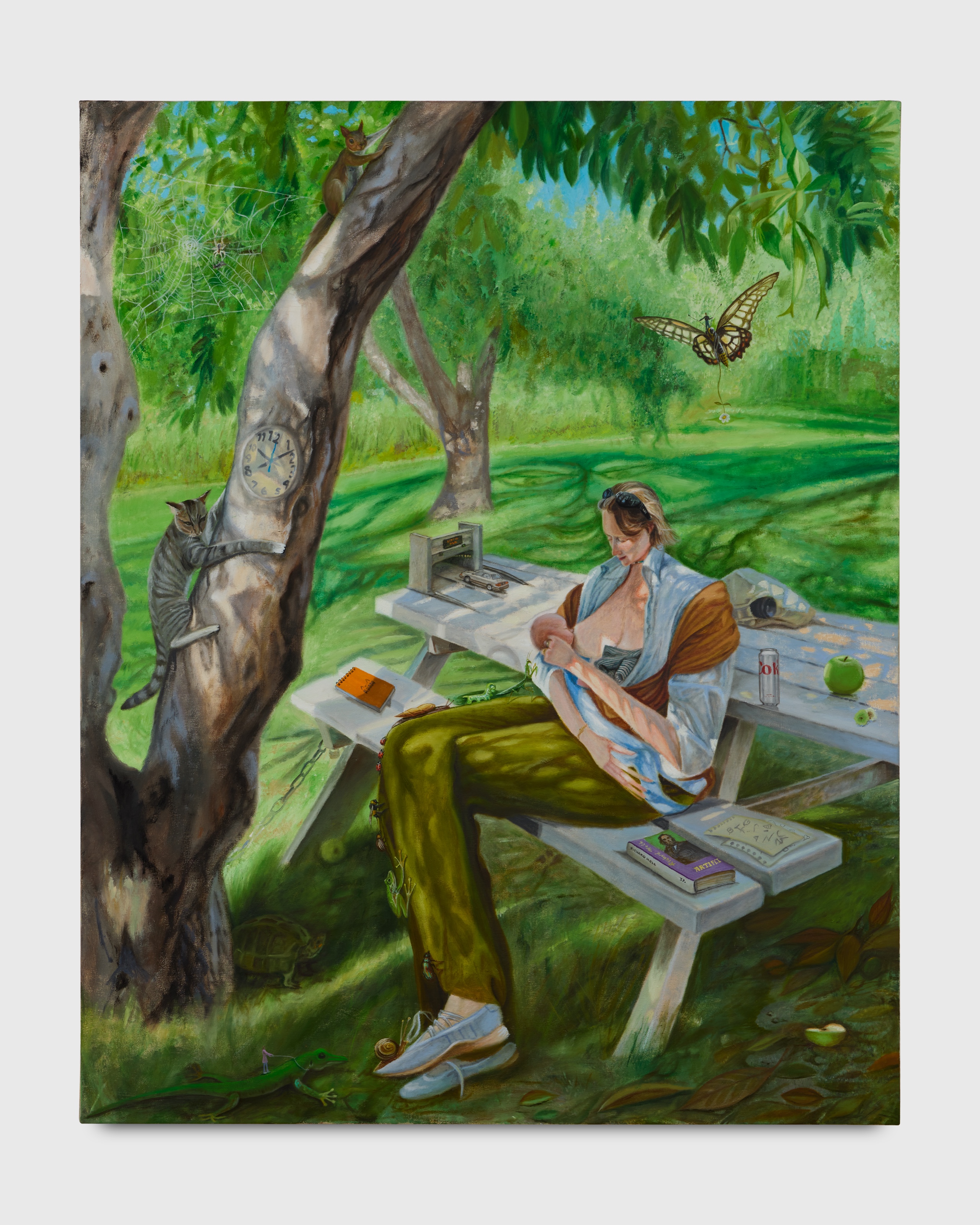
Cosmic Garden is painted from that vantage point, across a picnic bench, across a garden in Oslo, toward a woman nursing a child. Charlie Roberts is painting his wife Vic and their newborn son. The view is his. And because it is his, it holds everything he sees, everything he feels, everything he fears and loves and cannot say.
Norway is the grass and the trees and the long summer light. New York is everything else, the Diet Coke sweating on the bench, the green apples, the Richard Hell paperback, the faint skyline blurred into the treeline like a memory half-remembered. Vic brought these things with her. Their families are far away, and the objects stand in for them. Small pieces of home scattered across the wood.
The garden is not just a garden. It never was, in paintings. Manet knew it. Morisot knew it. The garden is the world made small enough to hold, a clearing where the things you love can be gathered together and, for one afternoon, watched over.
But Roberts knows, and the painting knows, that the world doesn’t stop at the garden gate.
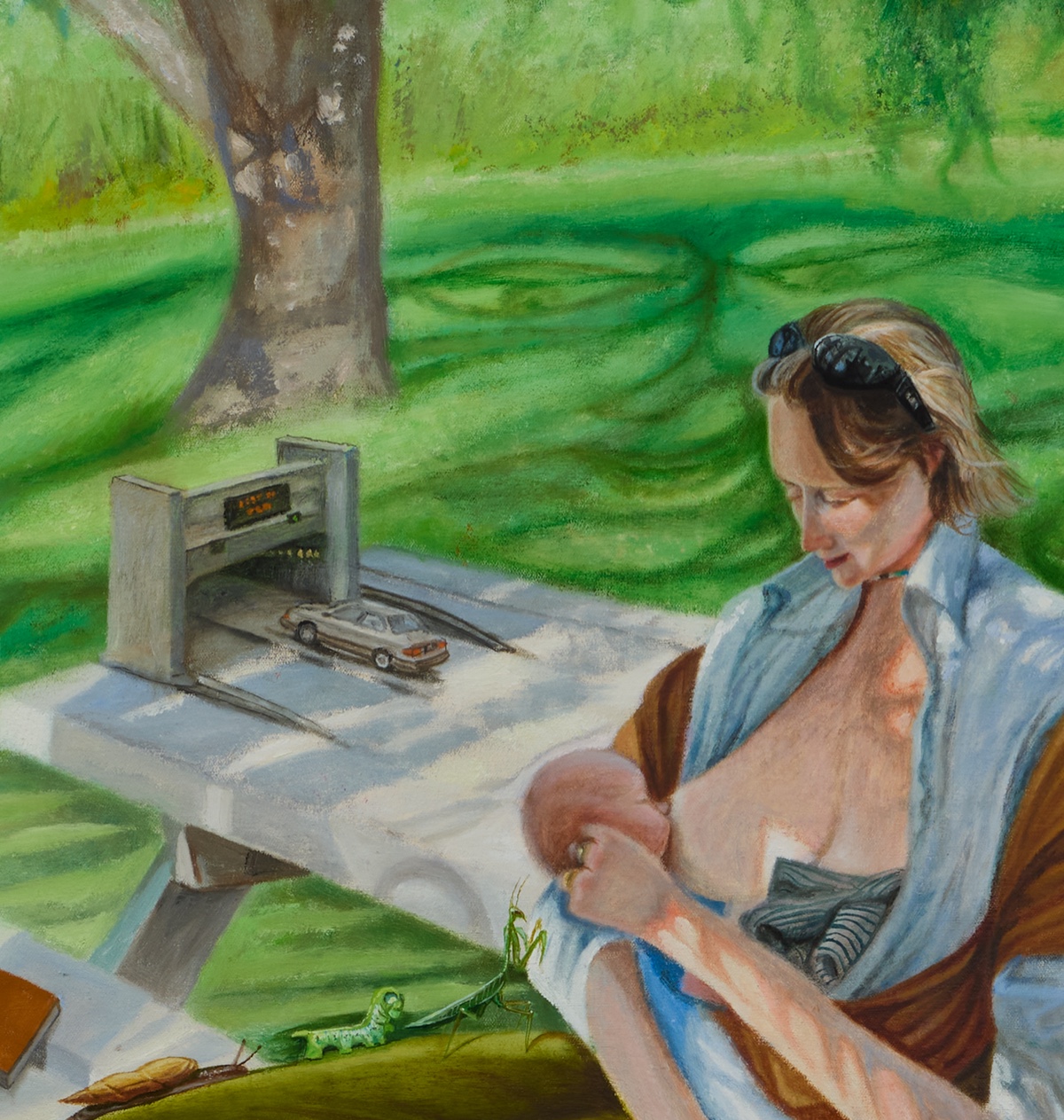
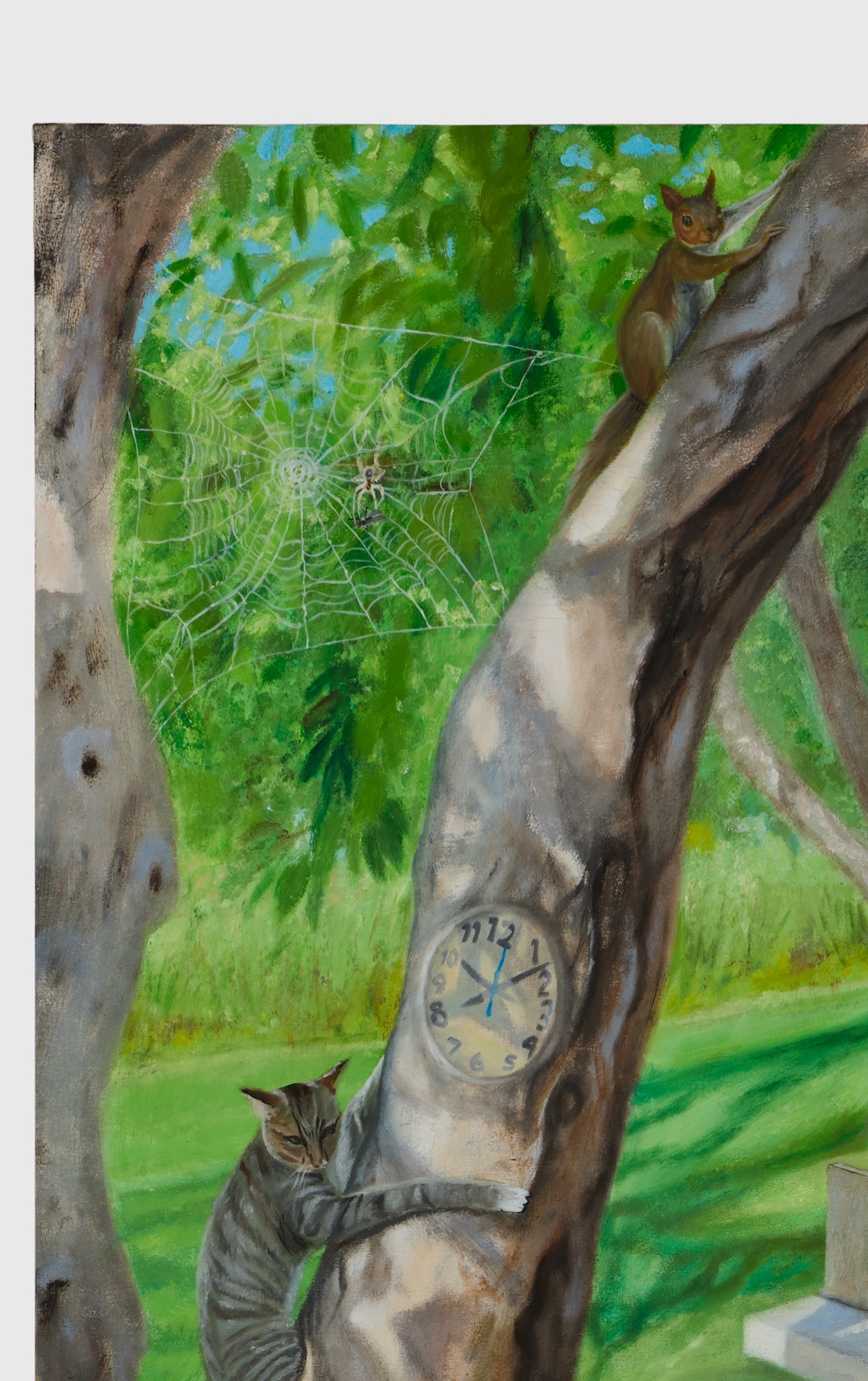
A spider has strung a web in the high branches. A cat chases a squirrel up the trunk. A clock is embedded in the bark, going nowhere and everywhere at once. And up Vic’s leg, a procession is arriving. Beetles, frogs, caterpillars, a bumblebee, they have come through the grass and found their way here. At the front, a mantis has nearly reached the baby’s head. At the back, a snail is still at the shoe, with the longest road ahead. On the grass nearby, an iguana stands and watches the whole thing, carrying a small rider on its back. An iguana eats insects. But not today. Today it stands aside.
In the canopy, something hides. A butterfly patrols the middle air carrying its own small armed rider. The garden is full of guardians, some expected, some unlikely, some that had to put old habits aside to be here.
This is Roberts’ temperament: Bruegel and Biggie, Fragonard and Rick Ross, the tender and the threatening laid out without hierarchy. He works corner to corner until every inch of the picture is inhabited. The good things and the bad things are always in the same garden, at the same time, competing for the same light.
What makes Cosmic Garden ache is that Roberts isn’t hiding any of this from his son. The procession isn’t only there to enchant. It’s a kind of reckoning. This is what’s out here.
The clock in the tree trunk keeps time whether anyone watches. The leaves will turn. The baby will grow. The objects on the bench will scatter. But here, in this one afternoon in Oslo, everything is present at once, the whole enormous fact of a new life, held in the frame the way a father might cup water in his hands, knowing it will run through, wanting just for a moment to feel the weight of it.
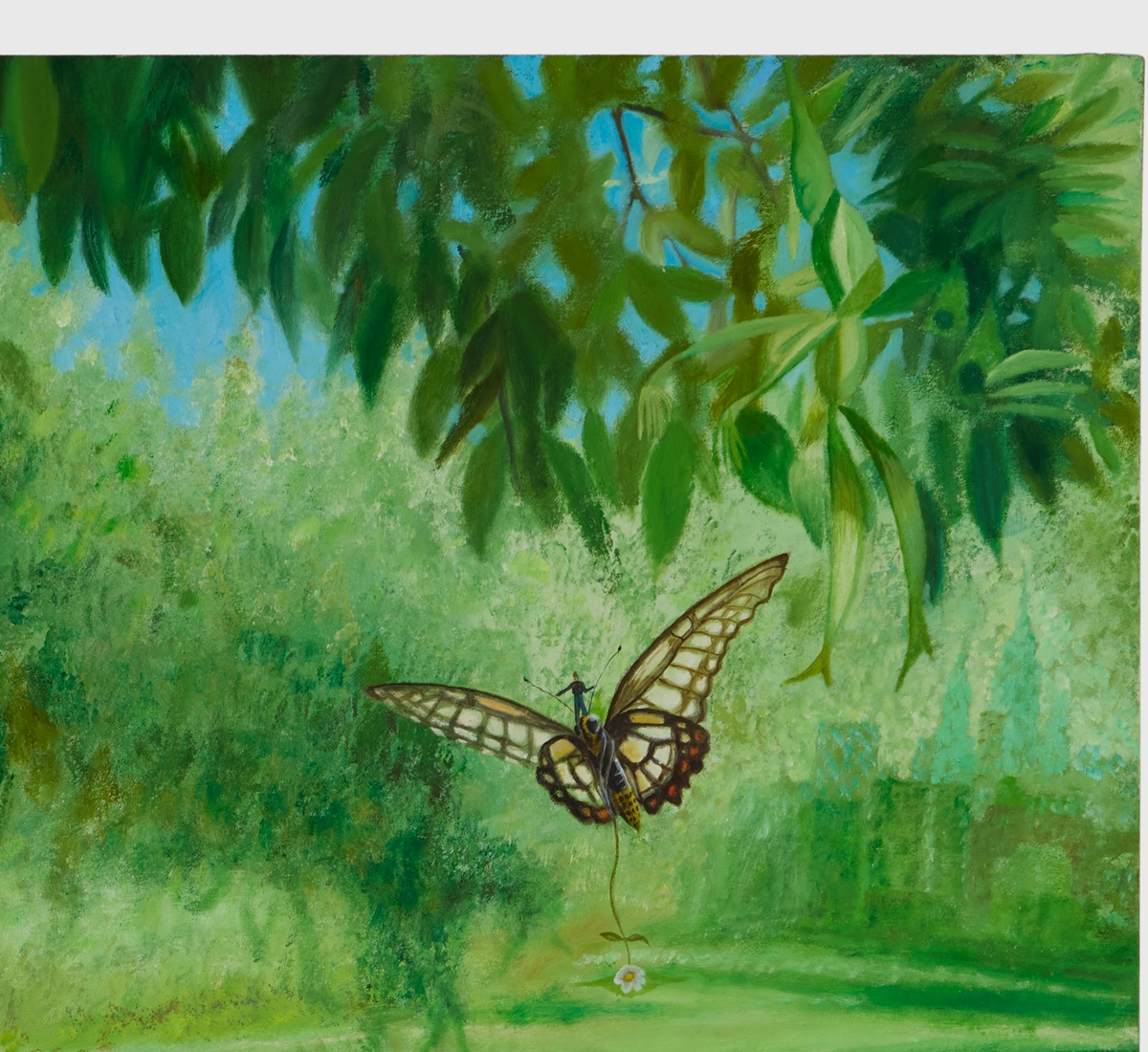
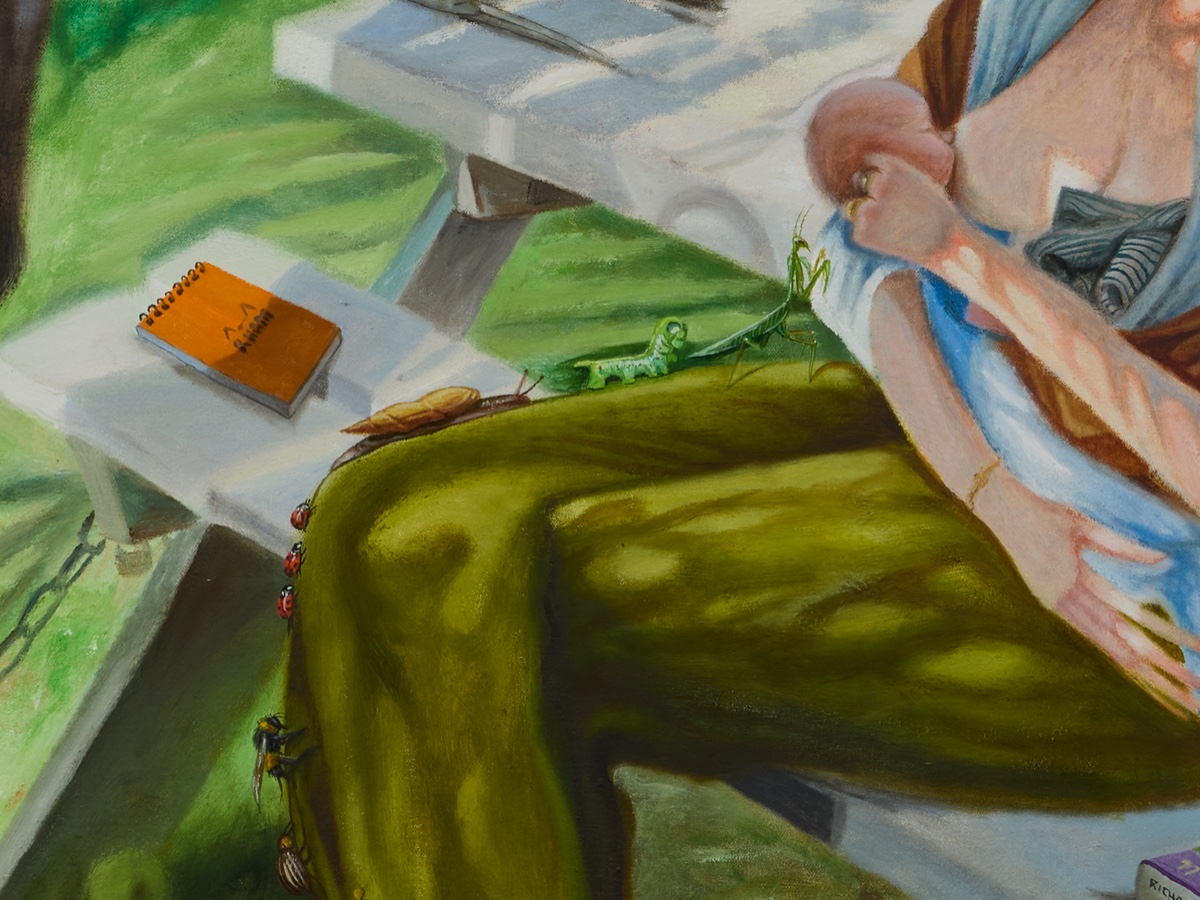
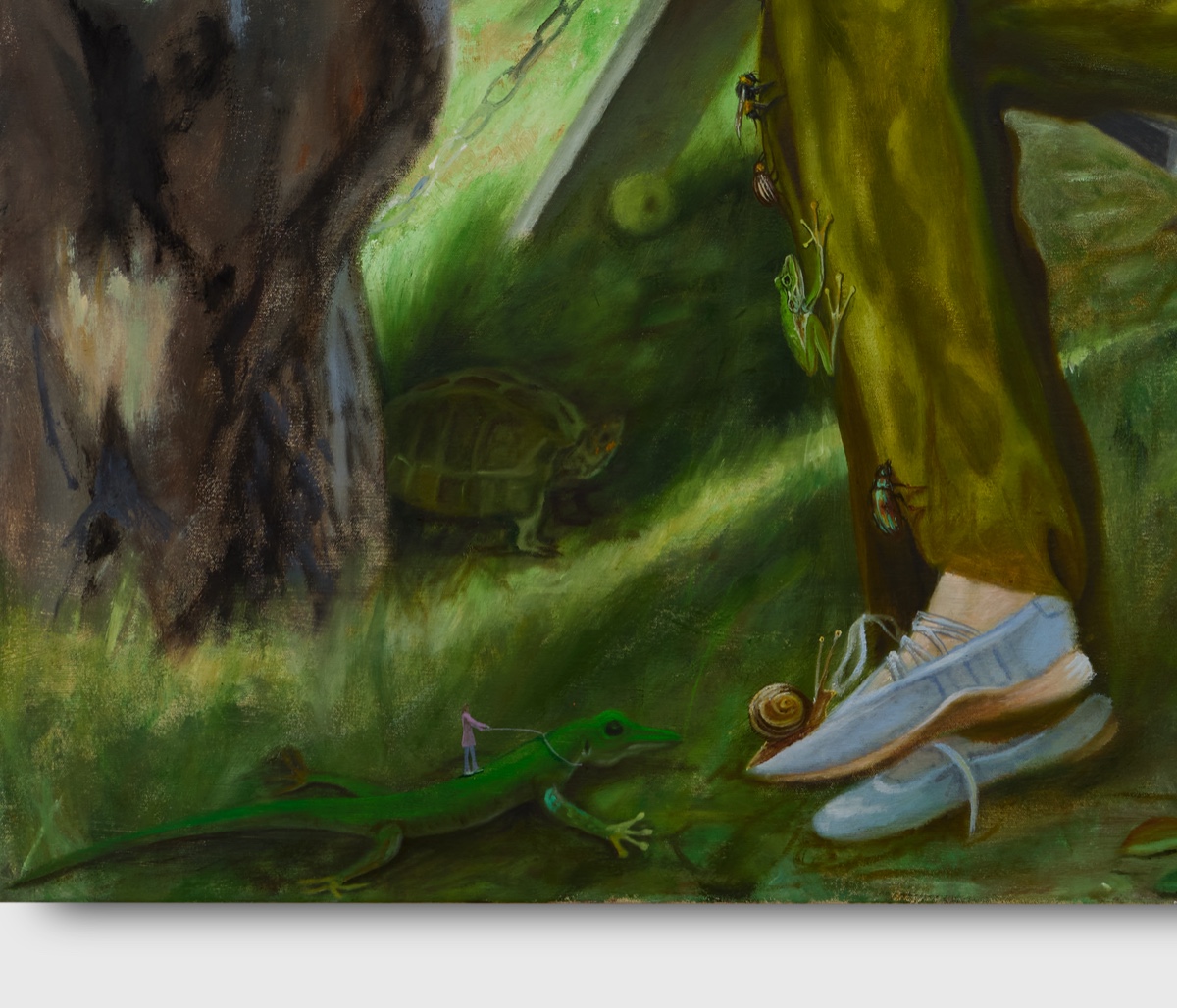
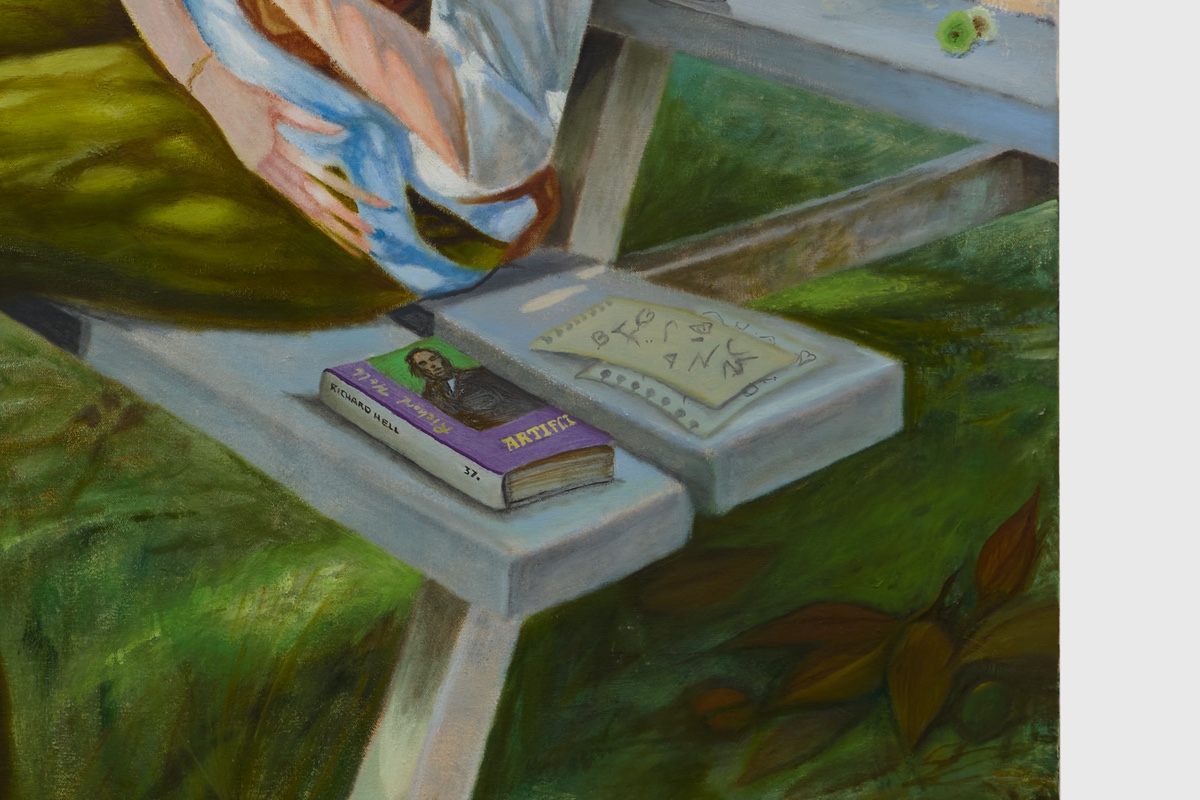
Roberts doesn’t cite his references. He uses them. Four centuries of painting and a punk paperback from downtown New York, all pulled into the same garden, all in service of the same moment.
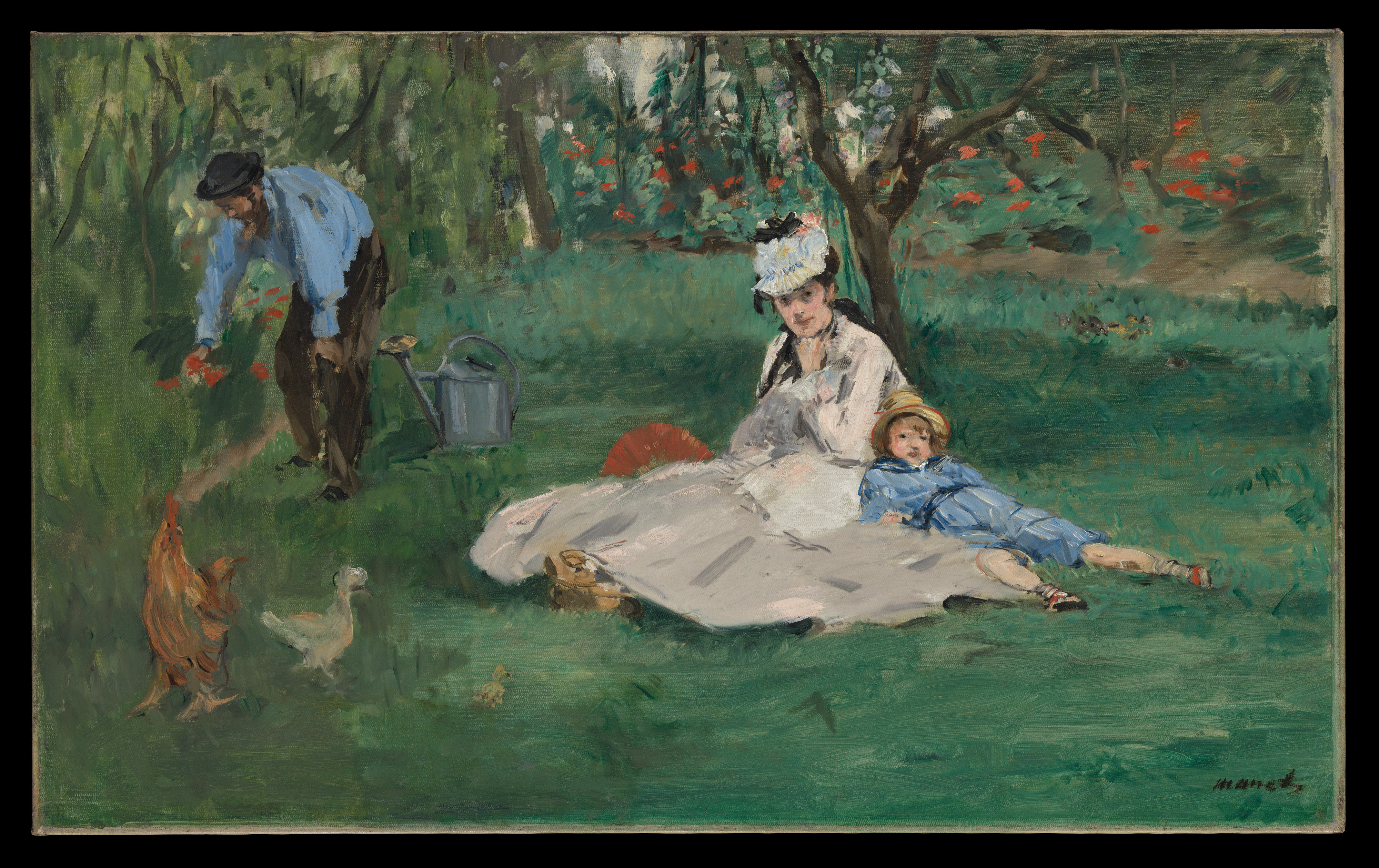
In the summer of 1874, Manet vacationed at his family’s house in Gennevilliers, just across the Seine from Monet at Argenteuil. One afternoon he set up his easel in Monet’s garden and painted Camille with their son Jean on the grass, Monet tending the beds behind them. While Manet painted the Monet family, Monet painted Manet painting. Renoir arrived uninvited, borrowed canvas and brushes, and painted the same scene from beside Manet’s shoulder. Three painters, one garden, one afternoon. Roberts takes the same subject: one artist painting another artist’s family outdoors, the domestic scene as the full weight of the world.
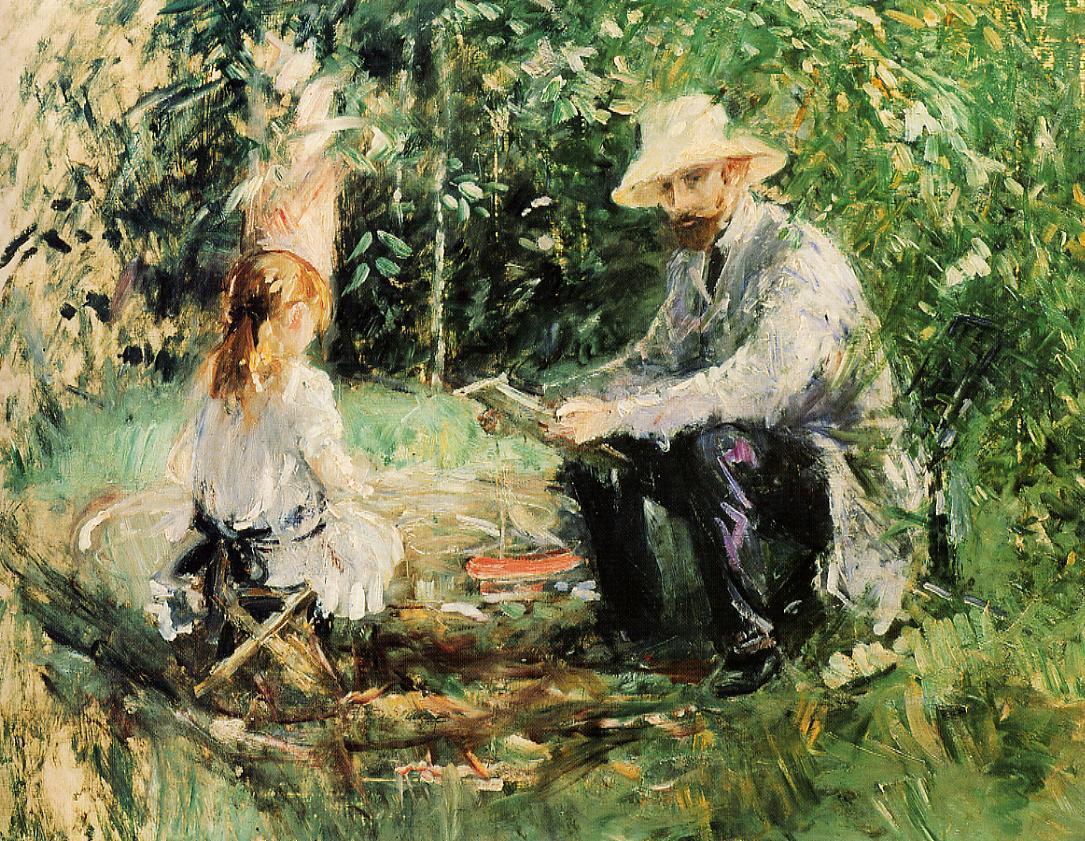
Morisot was a founding Impressionist and, from 1874, Édouard Manet’s sister-in-law, having married his younger brother Eugène. She painted her husband and their daughter Julie in the garden with the same seriousness other painters reserved for kings. The same tradition, from the inside. A parent and child outdoors, held in the frame like something that might otherwise slip away.
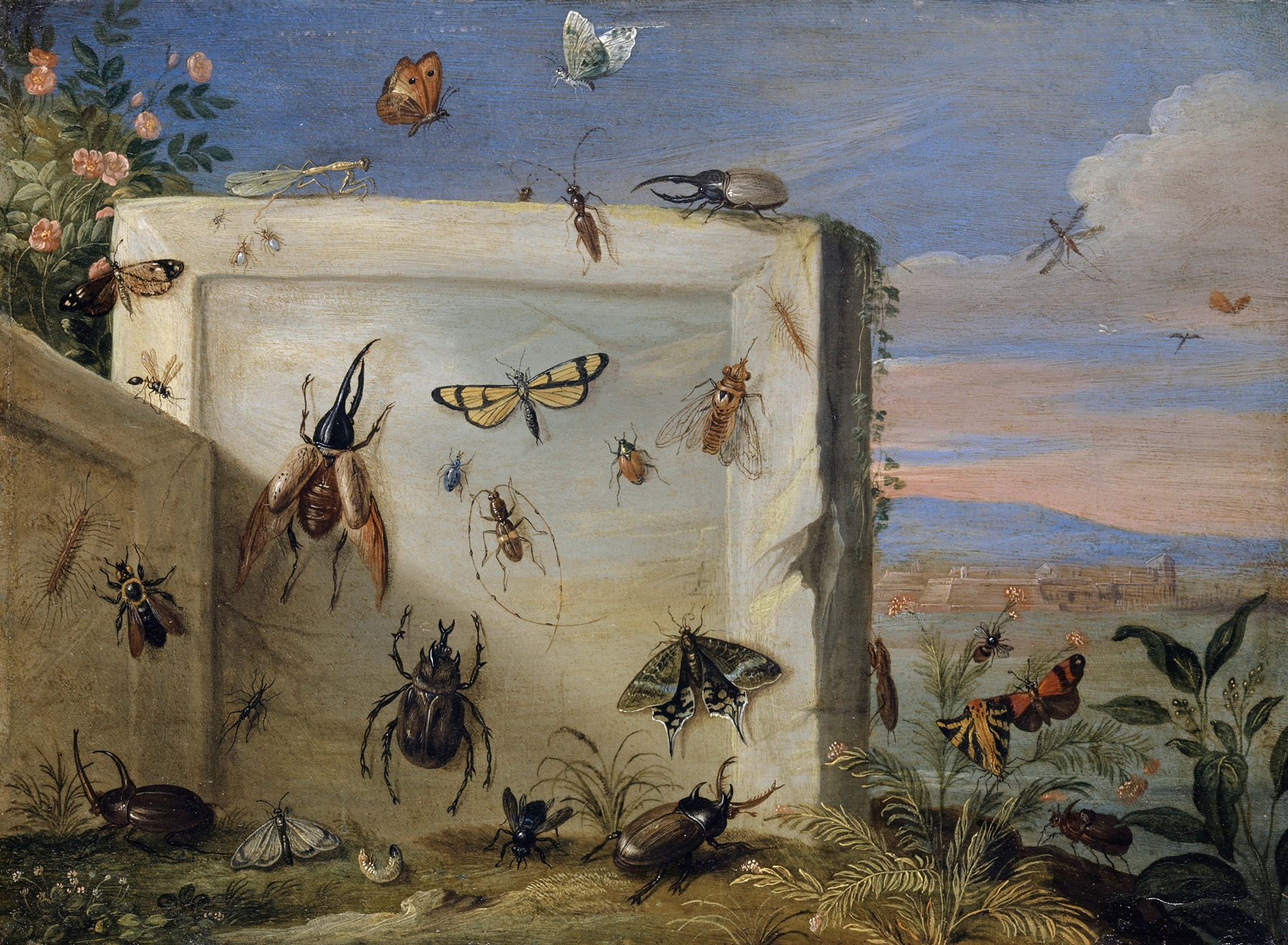
Grandson of Jan Brueghel the Elder, van Kessel spent his career painting beetles, moths, and butterflies with the attention most painters reserved for gods and generals. He laid them out on stone slabs and copper panels, each one observed as if it mattered. Roberts does the same. The iguana, the snail, the mantis making its way to the baby’s head: small creatures elevated to serious subjects, their procession painted with total conviction.
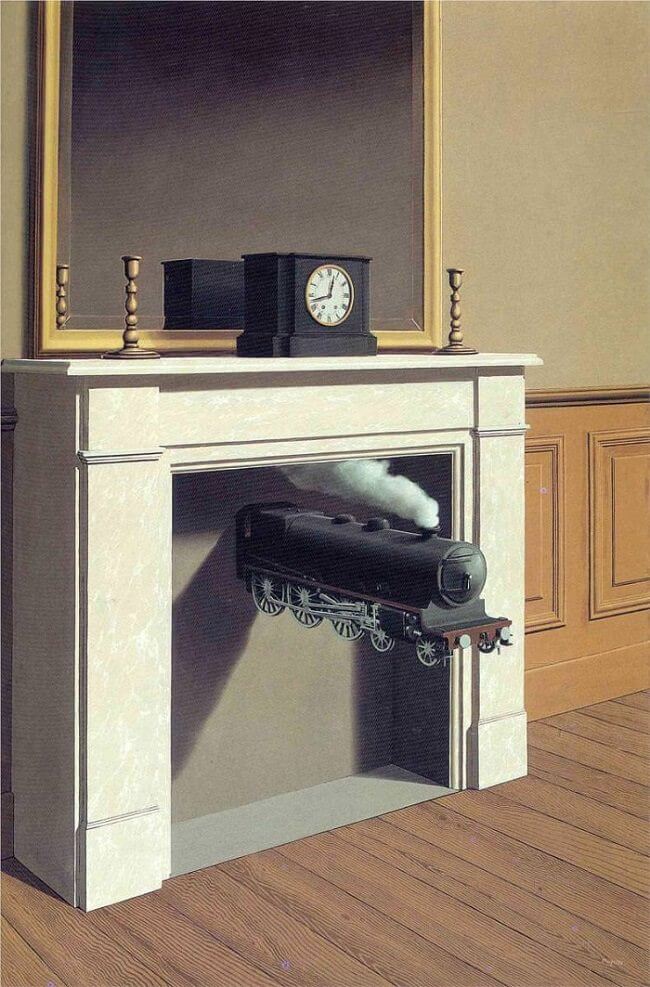
A locomotive emerges from a fireplace, trailing steam beneath a mantelpiece clock. A vehicle where it cannot be, entering an impossible opening. On the picnic table in Cosmic Garden, a small car drives into the Holland Tunnel — the same device: a vehicle entering the wrong kind of opening, a piece of one reality lodged inside another. The clock embedded in the tree trunk beside it deepens the echo. Magritte used the domestic interior to make the impossible feel inevitable. Roberts does the same in a garden in Oslo.
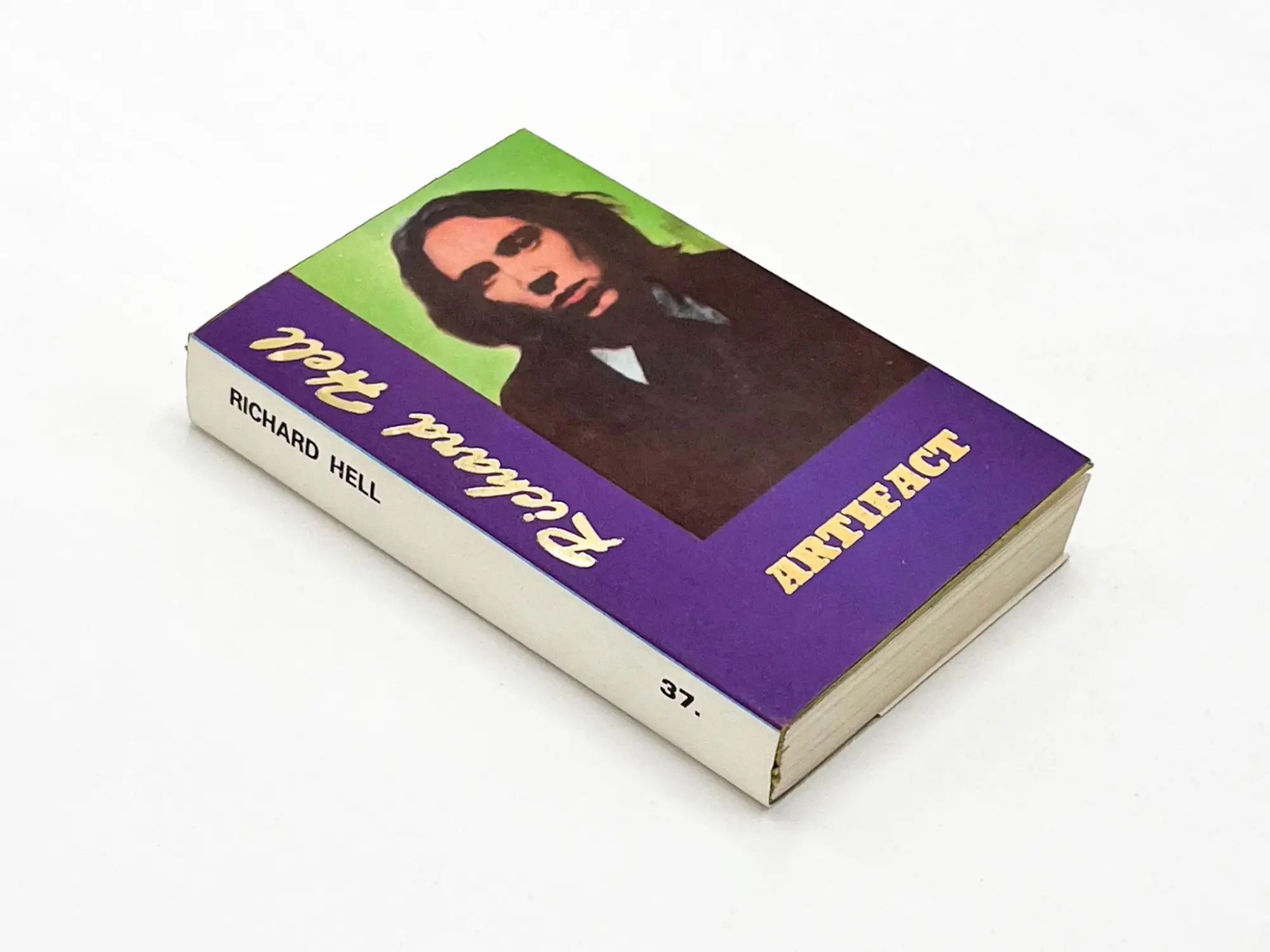
Hell co-founded Television, one of the first bands to play CBGB, and later formed Richard Hell and the Voidoids, whose 1977 album Blank Generation helped define what New York punk could be. Artifact collects the journals he kept through those years, originally scrawled into a dimestore notebook given to him by Patti Smith. Hanuman Books published it in a tiny palm-sized edition, a few inches tall, now very rare. It sits on the lower bench in the painting beside Vic — a sliver of downtown Manhattan carried into a Norwegian summer.
Swipe to see more →
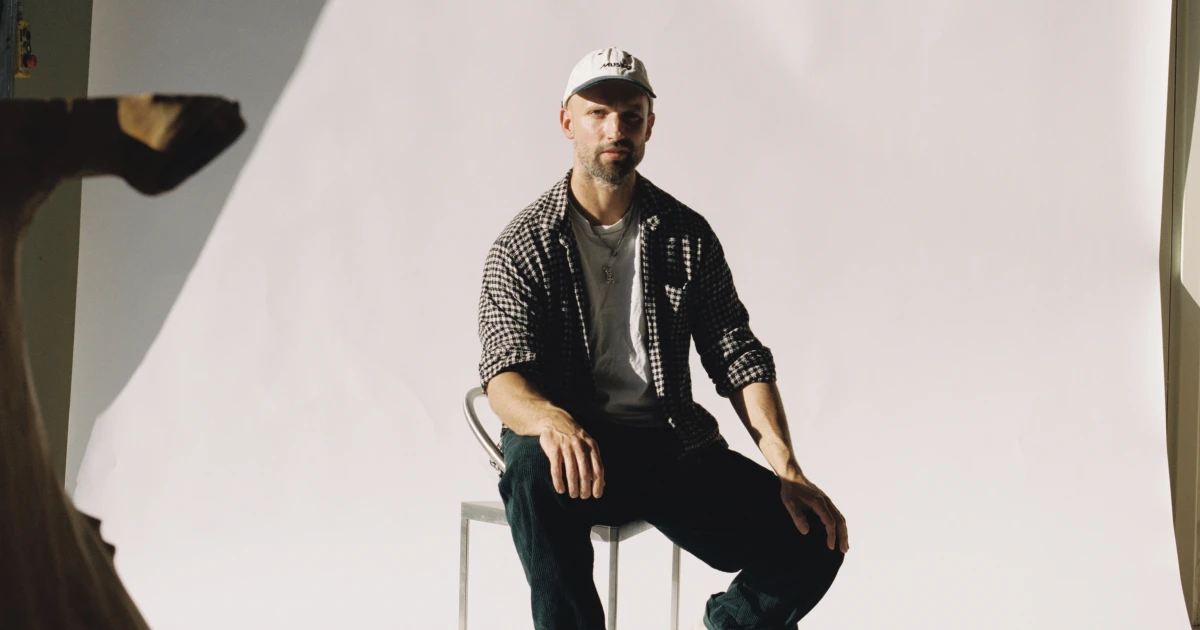
Charlie Roberts was born in Hutchinson, Kansas in 1983. He studied at the University of Kansas and the Emily Carr Institute of Art and Design in Vancouver, where he worked as an assistant to the Dutch artist Peter Schuyff, who became his mentor. He graduated in 2005.
He taught himself to paint by copying old masters in miniature. When that process became too tedious, he picked up a chainsaw. The sculptures he carved from raw wood, somewhere between tribal art and pop culture, became a counterpoint to his paintings: physical, rough, satisfying in a different way. The two practices have informed each other ever since.
His paintings are densely layered and compulsively detailed, built corner to corner over weeks until every inch of the picture plane is inhabited. He draws on art history, hip-hop, folk art, and pop culture without ranking one above anything else. Bruegel and Biggie Smalls, Fragonard and Rick Ross, the Flemish still life and the street — all of it admitted into the same frame. The figures are elongated, wiry, precisely observed. The stories are crowded and alive.
Roberts has exhibited widely across Europe, North America, and Asia, with solo presentations at Palo Gallery in New York, Anna Zorina Gallery in Los Angeles, Marlborough Contemporary in London, WOAW Gallery in Hong Kong, David Risley Gallery in Copenhagen, Galleri Magnus Karlsson in Stockholm, and eiklid / rusten in Oslo. His work has been covered by Artforum, Art in America, Juxtapoz, and It's Nice That. He has been profiled by Louisiana Channel in a series of interviews filmed in his Oslo studio.
"The paintings that sing throughout time are the ones that caught this energy that is really hard to catch, so when people can catch that, it is amazing."
— Charlie Roberts, Louisiana ChannelTo enquire about this work, arrange a viewing, or request additional images and documentation, please contact us directly.
Enquire by EmailA 5% levy on all sales of visual art in Norway above NOK 2,000. Collected by Bildende Kunstneres Hjelpefond (BKH), the Visual Artists' Aid Fund. The money goes to stipends, grants, and prizes for working artists in Norway — all career stages, regardless of nationality.